

The Deep Song
Flamenco without flounces - but with fancy footwork and real feeling.

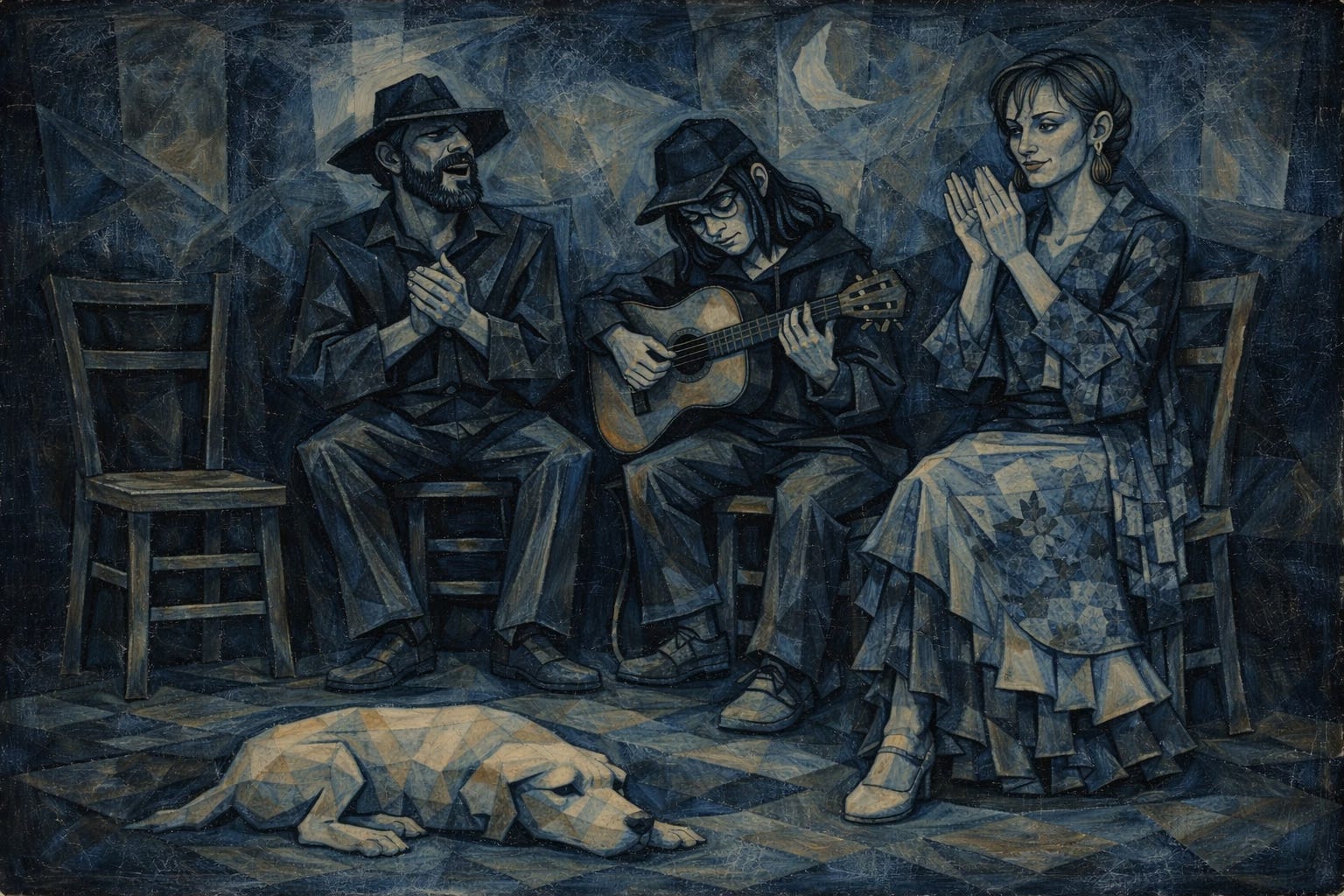
Once again I am obsessed.
We’re not long back from a glorious ten days in Málaga. For years, when the children were small, we drove straight from the airport to whatever rural retreat we had booked, bypassing the city entirely. That was a mistake. The birthplace of Picasso — the source of many of his icons: bulls, fathers, guitars — is a great city.
It is glorious for the sun, the food, the art — yes.
But above all, for the music.
I arrived excited about carnival, but I’d been thinking a lot about the politics of musical opposition. About Springsteen
channeling Dylan and Jesse Welles also grasping backwards to the 60s to find the right words. ,
Thinking how few artists had come up with anything visceral enough to grapple with the enormity of the USA’s counter-revolution — although Earth to Eve does capture some of the fear and fury.
But nothing felt significant until Bad Bunny’s glorious half-time show at the Super Bowl. A funny, generous rebuke, tweaking Trump’s nose with his Spanish-language celebration not only of Puerto Rico but of all the Americas.
The cry of “¡Viva Cuba!” must have gone down like a cold bacalaíto slapped on the counter in Magaland. The whole show was an expansive, exposition of what I think of as the ‘Bunnroe Doctrine’.
Full of such musings about music as resistance, I arrived — and outside the cathedral heard this.
It’s more than six thousand miles that separate Bad Bunny, the world’s top-selling pop star, reportedly worth $100 million, and his vast Super Bowl half-time performance from the woman singing for coins outside Málaga Cathedral.
These two performances live in different worlds. One: a defiant Spanish-language extravaganza involving four hundred dancers, so lavish that several online videos decode the symbolism of telegraph poles and figures dressed as sugar cane.
The other: a woman with a headscarf, a battered paper cup — and a voice. A searing lament.
Neither are not protest songs in the conventional sense. “Protest” suggests, organised marches, banners put away until the next demo. This is not that. Not Springsteen.
Both carry something deeper: defiance and pride, anger and sorrow.
The same is true of my latest obsession: flamenco.
“Flamenco is the music of Málaga,” said our taxi driver, enthusiastically tuning his radio to demonstrate.
Not strictly true. Flamenco’s historic birthplaces lie elsewhere across Andalucía — Seville, Córdoba, Jerez. But Málaga has adopted it with conviction. From buskers to beggars, from tourist-trap tat to serious tablaos (flamenco clubs), you hear it everywhere. And see it. It is the sort of music you have to experience live.
We arrived a few days after torrential rain in the mountains when, for a couple of rare days, Málaga’s river — the Guadalmedina — was not a dry concrete channel but a rushing torrent, carrying brown mountain water out to sea.
One street back from this sudden gush, on Pasillo del Matadero, sits the Kelipé Centre — a small tablao. Dark, intimate. Tables crammed close together. In the front row you are almost on stage.
I am a dilettante — an intermittent enthusiast, not a true aficionado. I don’t know my malagueñas from my bulerías(distinct flamenco song forms), but I try to catch flamenco whenever I’m in Spain. This performance reignited my enthusiasm and, combined with my New Year’s pledge to explore more back catalogue, has led to serious listening since I returned home.
This was probably the best flamenco I have ever seen — brimming with raw, unsentimental power. Thanks to Susana Manzano, Azukita and El Gordo for an astonishing performance.
It began sparsely.
The cantaor (singer) and tocaor (guitarist) sat aligned on straight-backed chairs, leaving a third chair empty.
The guitar was superb: confident without showiness, precise, steely, utterly assured. No flourishes. Just control.
Then the voice.
He wore a grey suit, open-necked shirt, dark trousers. Short hair, neat dark beard. Modest in bearing. Utterly conventional.
But from him came an extraordinary sound. Not conventionally beautiful. Almost an anti-voice. It broke Western melodic expectation, releasing something raw and elemental.
Yet entirely orthodox within flamenco.
Pure quejío (the piercing cry) at the heart of cante jondo (deep song).
It was already intense, but it snapped into another gear when Susana hit the floor — literally. From the moment she entered, she stamped, marched, made percussive contact with the stage.
Her zapateado (rhythmic footwork) grew urgent, bordering on transgressive as she lifted her skirts above her knees to facilitate the acceleration — like an engine gathering speed. Her taconeo (heel strikes) picked up the tempo.
Her dance is integral to the music. She smashes out the rhythm with her feet.
Supercharged. Almost unbearable.
Utterly enthralling.
She looks genial — a woman of a certain age, perhaps wearing a little too much make-up. If you passed her in the street, you might take her for an eccentric art teacher, fond of yoga.
She wears none of the traditional flamenco dress — no flounces, no lace — just dull brown satin and that slightly floral outer layer. She is making a point: real flamenco isn’t pretty or cute or sweet. The intensity of her dance could not be made more magnificent with a mantón (embroidered shawl), nor could the drabbest clothing conceal its glory.
What is striking is that the three of them seem equally enamoured of the performance and of one another, leaning in to smile and encourage. It is one of the paradoxes of flamenco that it exists within a tight formal framework, yet encourages spontaneity and improvisation.
Between pieces, the guitarist spoke rapidly, switching between English and Spanish. He told a story involving a professor, a play, pride in heritage. I did not entirely catch the argument, but the point seemed clear enough: their longest, most serious piece addressed directly the endurance of the Romani people.
You can hear all the history in that wail — that threefold echo from the East, three traditions stretching a single syllable across multiple notes.
The influence of Al-Andalus is unmistakable. The lute precedes the guitar.
The Moorish call to prayer echoes in the ornamentation.
Jews, Moors, Roma — the standard account speaks of three marginalised communities blending traditions.
Perhaps that story is too neat.
But the tonal overlap is undeniable.
After the fall of Granada in 1492 and the expulsions that followed, cultural memory did not vanish. Styles bled. Ornamentation migrated. Grief found common shapes.
The symbol is tidy. History rarely is.
But in the voice — that soaring, tearing cry — you hear something older than modern Spain.
As Picasso said: “To me there is no past or future in art. If a work of art cannot live always in the present it must not be considered at all. The art of the Greeks, of the Egyptians, of the great painters who lived in other times, is not an art of the past; perhaps it is more alive today than it ever was.”
The same is true of flamenco.
It is a living memory — a conversation between then and now, here and there. It tells of exile that made people strangers in their own land, ravaged by sorrow, overwhelmed by joy.
So when we emerged into the night we found ourselves surrounded by another tradition with a message for authority - this is another three parter - songs of rage part 2 of Malaga Music, tomorrow.