
Saving Grace - Robert Plant
An Elder God of Rock's brilliance from the borderlands

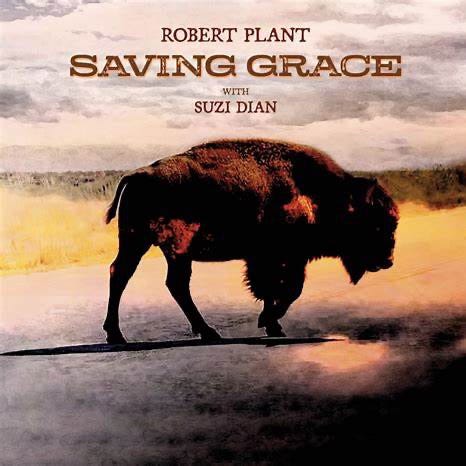
The album I’ve been returning to, time after time this week, is Saving Grace — like the bison on the cover, a thing of great power and beauty, recalling an America that disappeared long ago. Or perhaps never was
.
This is the latest release by Robert Plant, Led Zeppelin’s one-time lead singer turned musical pilgrim. He’s one of those admirable musicians of a certain age — in his case 77 — who’s never grown stale, never stopped questing for new sounds, and never ceased trying to make music he actually loves, even if that means taking a few wrong turns along the way. This, though, is most certainly not a wrong turn. It’s an experiment gone delightfully, wonderfully right.
Saving Grace — both the name of the band and the album
— is remarkable not only for the music but for what it tells us about Plant himself. who about seven years ago had returned from Nashville to his UK home in Worcestershire. . Recorded on the Welsh Marches with local musicians, it has a quality that is at once grounded and dreamlike. Many ageing rockers use collaborators like a Zimmer frame — something to prop them up in their artistic frailty, to help them shuffle forward just a little. Not Plant.
So anyone yearning for that Led Zeppelin reunion will almost certainly not get their heart’s desire but they could do worse than listen to these newly released live songs from 1976 and 79.
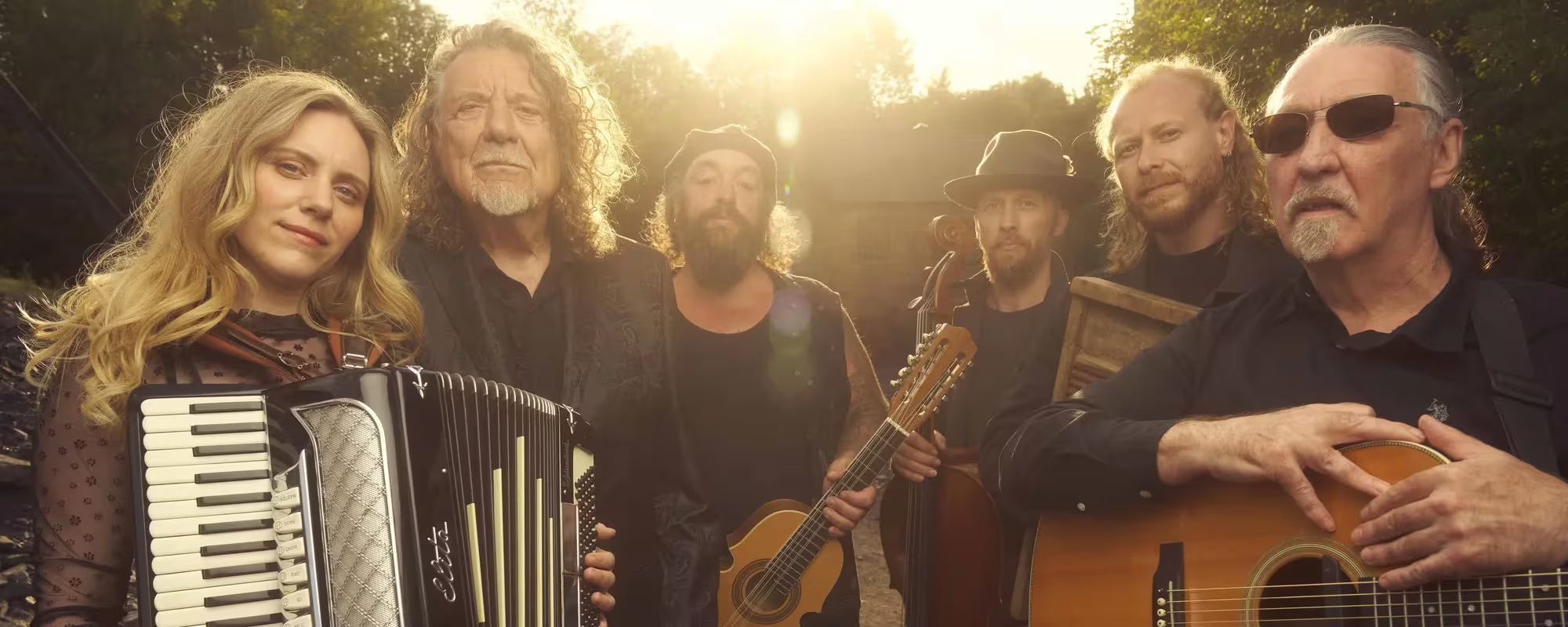
This new magic began in 2018 when Matt Worley, a banjo and strings player and fellow roots enthusiast, struck up a chat with Plant in a bar. The two quickly discovered they were, to paraphrase Plant, students in the same department of the Library of Joy. Before long, they decided they simply had to play together. Then Kidderminster based mandolin and guitar player Tony Kelsey joined. Then bassist, accordionist and singer Suzi Dian and her husband, drummer Oli Jefferson, followed soon after. The final member, Barney Morse-Brown, is a classically trained cellist who had made a name as an ambient experimenter under the name Duotone — and all the band members live within 40 minutes of each other
.
The sound of the album is largely acoustic — sparse and precise — a banjo picked here, an acoustic guitar there, backed by cello and lent some colour by the occasional discordant electric guitar. But the core of it all is the way the voices of Dian and Plant harmonise so closely they become a single sound before moving apart and swooping around each other.
The former music teacher gets joint credits on the front of the album and fully deserves the accolade.
This all came together around the time of lockdown. And when they finally emerged, something remarkable happened. They began gigging in their local area playing tiny venues and village halls across Worcestershire and the Welsh borders. Then came a scattering of dates on the folk circuit in the west of Ireland. Astonishing, really, for a man who could still fill stadiums anywhere in the world. It speaks not just to his humility, but to his devotion to the craft — and to the extraordinary musicians he’s chosen to surround himself with.
There’s a sense that he’s seeking something purer: a return to roots, the quiet alchemy that only happens when music can breathe in small rooms. He talks often about joy and laughter, and despite the downbeat emotions of these tunes you can hear both woven into the fabric of these songs.
That extraordinary attitude is most clearly revealed in my favourite track on the album — not an easy choice, but I think it has to be the classic blues number Soul of a Man.
Remarkably, Plant doesn’t even sing lead on it. He leaves the vocals to Matt Worley, content to add a little light harp. The astonishing guitar — fuzzy, restrained, yet brimming with power — comes from Tony Kelsey, who once worked with Alvin Stardust and The Move, but has mostly kept to low-profile session work since. Here his playing burns with quiet authority. Plant seems occasionally content to be the man with the plan, and his confidence in his collaborators is clearly well placed as the tune first recorded by Blind Willie Johnson
is totally transformed.
The album will be filed under Americana, and rightly so. It fits the American Music Association’s definition: “bringing together the rich threads of country, folk, blues, soul, bluegrass, gospel, and rock.” Yet one of the genres key features, aside from the washboards and banjos, is that it evokes a melancholy for a lost America — an America that will never return because, if we’re honest, it never really existed. The bison on the cover is not merely emblematic — it’s a ghost.
But Saving Grace is something else again: Americana filtered through the Black Country and the Severn River Valley, which Plant calls, with a nod towards mythologising the space, “The Shire” — and it was indeed the landscape which inspired Tolkien. Listening, I first thought Plant was conjuring a landscape wider even than the American prairies — perhaps embracing the Argentinian pampas, perhaps the tundra, certainly his own home hills — all those liminal, wind-torn places where myth and geography blend. But on closer listening I realised he wasn’t summoning a single landscape at all. Each song creates its own small mythology — its own geography, its own history. Utterly coherent. Utterly unreal.
As Plant puts it, after six years of working together they had managed “to form our own little, tiny breakaway republic — this combination of all different manner of music played the way we feel.”
The clue lies in the songs themselves. They’re all covers — several drawn from the deep wells of early blues. Chevrolet, a traditional number covered by Memphis Minnie and Taj Mahal, is one. There’s a spine-tingling version of the traditional Gospel Plough,
delicate banjo and acoustic guitar intertwining beneath near-perfect harmonies from Plant and Suzi Dian — less energy but much more atmospheric than the harp-driven barnstormer of a version from Dylan’s first album.
But the selection roams far beyond the old and expected, embracing and transforming some more recent songs. There’s a fragile, shimmering take on Moby Grape’s 1969 psychedelic rock gem It’s a Beautiful Day, Today.
Only when you return to the original — a pleasant enough period piece —
do you realise the depth and strength of Plant’s voice here, the way he and Suzi weave around one another with such grace.
He clearly has an ear for hidden potential: The Low Anthem’s rather undistinguished Ticket Taker (2009)
becomes a showcase for layered harmony,
While their version of Low’s excellent Everybody’s Song is magnificent — trading rockist reverence for a touch more urgency, a flicker of the old roar.
Martha Scanlan’s Higher Rock (2018) gives Suzi Dian a well-earned turn in the spotlight, her vocals shimmering with quiet authority.
And then there’s a cover of a Sarah Siskind song written for the TV series Nashville — there it’s a rather mawkish number written for a fictional singer mourning another fictional character’s death (how’s that for metatextual ?) Here it becomes a power ballad that gradually builds until almost Zeppelin-like guitars lead into an extraordinary wordless wail of a duet.
Plant’s ‘breakaway republic’ is clearly a very fine place, whether inhabited by bison or hobbits or just some very good musicians having the time of their lives. Plant seems very happy, assuring Esquire magazine he will keep moving and will flourish in whatever he does next. He tells them what he has achieved in his life has been extraordinary — but that it would be the worst thing in the world for him to stop and live in that extraordinary moment. He adds “No suit, no toupee, and no Vegas. I’m just doing this stuff because it’s good.”
And it really is very, very good.
This piece started life as part of a post i’d planned to put out yesterday (Saturday) with six brief reviews of what I have been listening to this week -’endorsements and ear worms. But those rabbit holes beckoned so invitingly and when I emerged I kept writing until another one opened up. So Geese, Night Bus, Lola, Baxter and even TLDP will have to wait. Do let me know what you think of it all.