

“Brasil é legal!”
Brazil is indeed cool -but what makes the music so good ?

“Brasil é legal!”
“Brazil is cool!” shout the boys, as they bring the weekend traffic in São Paulo to a halt outside a café with their energetic breakdancing/street theatre.
Brazil is indeed cool, and fun, and nice — to give other possible translations of the slang word, which also means “legal”. It is particularly cool when it comes to music. So much so that it is quite difficult for a musical glutton like myself to know how best to feast on this all-you-can-hear buffet, and the snacks in between. I’m just back from a wonderful three week holiday in that country and this the first part of a three part reflection on the music there. I’ve tried to educate myself, but I am far from an expert so please forgive me for any howlers or crass interpretations.
Music is everywhere: from Shakira’s recent concert for two million people on Copacabana beach
to this gig, where rather fewer people enjoyed an impromptu performance on the way to another of the world’s most iconic beaches, Ipanema. Or this
dance in the town square of the Glória area of Rio.
There’s no doubt there’s a lot of music. Which begs the question: is it any good? And what does it say about the country?
There are scores of different streams of Brazilian music. This last was forró — a northern country dance music, one of the few genres that isn’t a tributary into samba, pretty much the national music, itself as wide and vast as the Amazon.
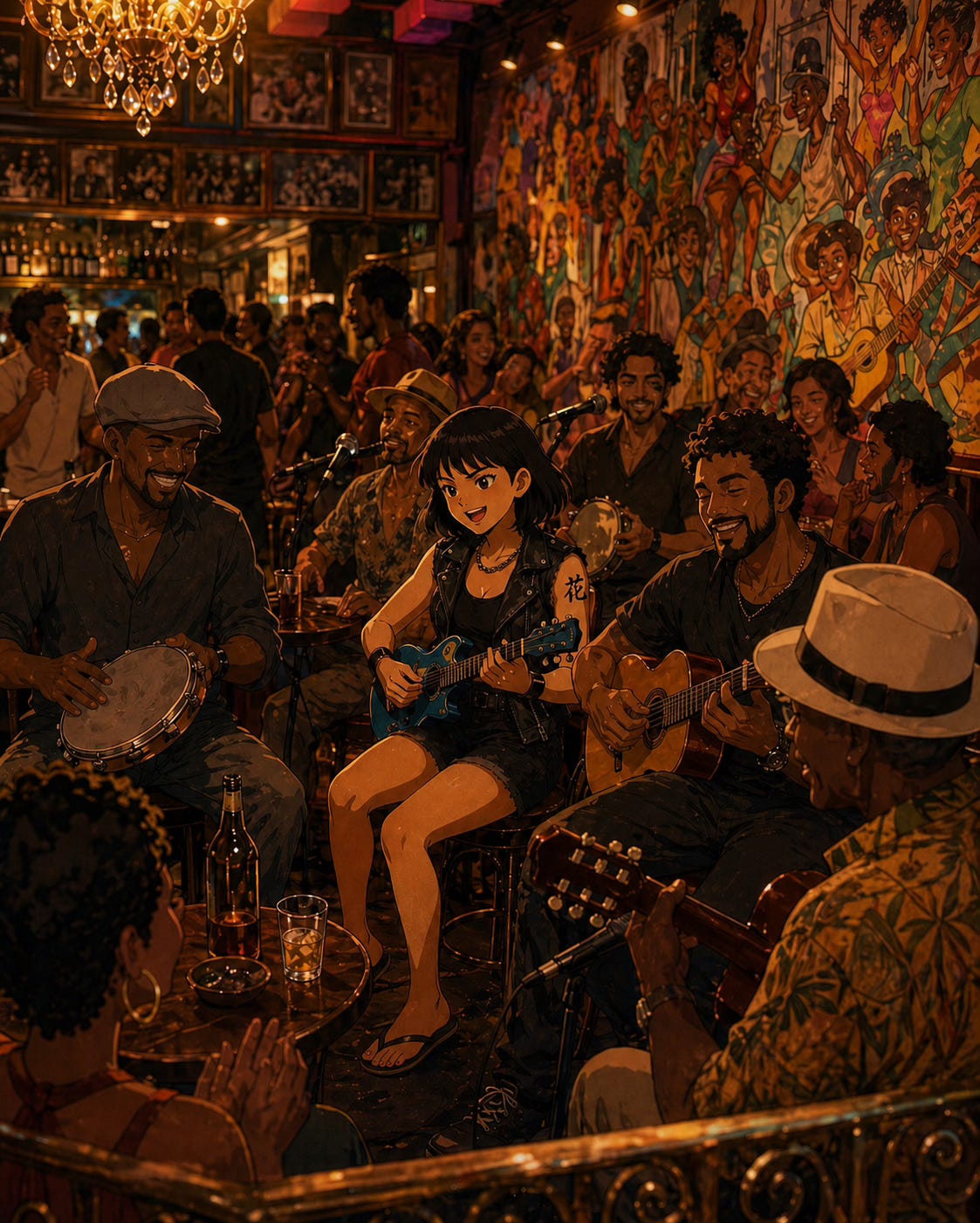
It is Saturday afternoon in Vila Madalena, a well-heeled area of São Paulo. The music is vibrant, lively, gentle and joyous. We’re in the Samba Café, where the house band are playing with gusto to an extremely appreciative crowd.
There’s a big guy with a cavaquinho — a sort of electric ukulele — a trombonist, several vocalists, and more percussionists. The music is as light as the food was not. In our case, a vast steak with chips
. But for most people here, as for most people in Brazil, if it’s Saturday, it must be feijoada: a heavy pork-and-bean stew, which is de rigueur on Wednesdays and Saturdays.
Most Brazilians seem to love it with the same patriotic fervour otherwise reserved for their music. I’ve long enjoyed Brazilian music, but often found the more traditional stuff too soft for my tastes. Even though I like my music joyous, in the past I have found too little bite in Brazil.
And at first glance, what is happening here is entirely appropriate for a Saturday afternoon after a substantial lunch. People seem to be swaying gently to light, familiar tunes. Until, that is, you look up and then down: at the feet and the faces. There is really some fancy footwork going on down there, and the faces are so full of joy.
Well, that’s not uncommon at gigs when people are seeing their favourite bands. But this is a different sort of crowd, a mix of ages from very young to very old. It’s wonderful to see middle-aged women on a day out, celebrating a birthday or just the end of the working week, looking so happy.
There are a couple of older guys in the crowd who really catch my attention. Both men are Black, in their 50s or 60s, beaming so widely, almost in ecstasy, lifting their hands to the air. It’s clear this isn’t music you just like. You love it with a passion.
Still, that softness does mean I can sway gently on my stick without feeling out of place. And this crowd are really friendly. The guy whose table I’m standing in front of keeps offering me a chair and filling my cup with beer.
Indeed, Brazilians generally are very warm and welcoming. It’s paradoxical: a country with a reputation for street crime and violence, where Paulistanos — people from São Paulo — vie with Cariocas — people from Rio — to warn you how dangerous their city is, and how you must never take your phone out outside, and yet their nature seems so open and generous.
During the band’s second set, things move up another notch. A samba composer they spot in the audience comes up and sings with them.
Then boys with drums strapped to their fronts come in, followed by two very tall and extremely glamorous dancers dressed in sequins, with huge feathers on their heads. They shimmy in carefully, not approaching any of the guys in the audience — doubtless too much experience of pinches and slapped bums.
This is an invocation of carnival — a medieval Catholic European institution that Brazil inherited, added polyrhythms to, anointed with glistening oil and glitter, and turbocharged with joy and sensuality. Then it gave it back, Brazil’s gift to the globe, making the old world’s version appear pallid and tame beside it.
The room’s joy quotient climbs.
My three weeks in Brazil were a marvel, and I know that while I’ve been there I’ve ignored some of the brilliant releases at home. So here’s a playlist of those that stood out from 6,000 miles away
-including the best yet from TLDP channeling the 70s, to the delightful 1000 Rabbits (who used to be Rabbit Foot) with their first releases, channeling the 2030’s. But forgive me if my mind was else where.
We were in part here to see where nosso filho mais velho e sua noiva ( our eldest son and his fiancee )live when they aren’t in Berlin, or generally being digital nomads, and in part to meet our new family. We had a superb time - and the best Feijoada I’ve ever had bu this didn’t stop my investigations, My son’s future sogra — mother-in-law — was for 20 years a dance teacher. For ten years she had her own studio, teaching dances like samba to adults, as well as gringo dances like tango. Now retired and a very youthful 70-something, she still loves music — although her current intense focus appears to be K-pop, clearly a woman after the Department’s own obsessional heart. So I take the opportunity to ask her what is so special about Brazilian music.
She replies without hesitation: percussion.
That answer is both simple and enormous. Tomorrow: why percussion is not just a sound in Brazil, but a history lesson.
Gringo, in Brazil, means any foreigner, including Spanish speakers from Latin America. It isn’t at all pejorative, nor does it mean American or white, as it can in Mexico. The word comes from a Spanish expression similar to “it’s all Greek to me”, first used in Spain about the Irish in the late 18th century.
Thanks - it was amazing -are you in the Azores ?
Wow! Looks and sounds amazing Mark. Great insight and look forward to more instalments